-cropped-2.svg "Savvy-CFO Logo")
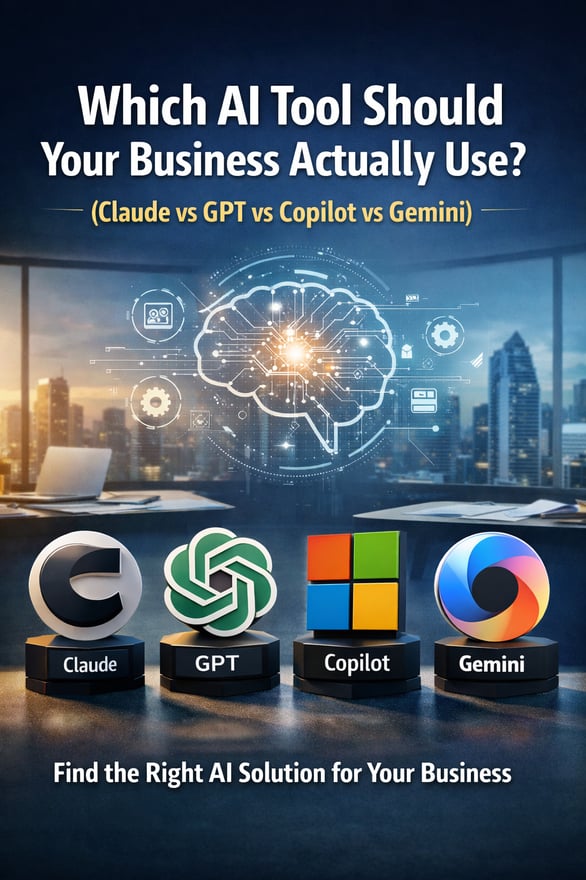
Stop Asking “Which Is Best” - You’re Asking the Wrong Question
Every week, there seems to be a new headline:
- “GPT just got better”
- “Claude is now the smartest”
- “Gemini is catching up”
- “Copilot is embedded everywhere”
And businesses keep reacting the same way:
“Which one should we use?”
Here’s the uncomfortable answer:
If you’re trying to pick one model, you’re already behind.
1. These Are Not Competitors: They’re Different Tools
Most comparisons treat these models like interchangeable software.
They’re not.
They’re closer to:
- Hiring different employees, with different strengths, and inside different systems
| Model | What It Actually Is |
|---|---|
| GPT | A flexible “generalist analyst” |
| Claude | A structured “writer + policy thinker” |
| Copilot | An “embedded employee inside Microsoft” |
| Gemini | A “research assistant tied to Google” |
Trying to pick a winner is like asking:
“Should I hire a CFO, a lawyer, or an operations manager?”
Wrong question.
2. Where Each Model Actually Wins (No Marketing Spin)
GPT - The Most Useful, Not the Best
GPT is the closest thing to a default operating layer.
It’s not the best at everything, but it’s good enough at almost everything.
Where it stands out:
- Financial analysis
- Structuring messy problems
- Building workflows and automations
- Acting as a “thinking partner”
Where it falls short:
- Can feel generic without strong prompting
- Output quality varies with user skill
- Costs can creep up at scale
Savvy take:
GPT can be your core engine, not your polished output layer.
Claude - The Most Underestimated Business Tool
Claude doesn’t get as much hype, but in practice, it’s often the best model for anything outside your company.
Where it stands out:
- Board decks
- Investor memos
- Policy writing
- Long-form clarity
Where it falls short:
- Less flexible for automation
- Smaller ecosystem
- Not built for heavy operational workflows
Savvy take:
Claude is your communication layer. If reputation matters, this is where you lean.
Copilot - 'The Most Boring (and likely Most Adopted)
Copilot is not flashy. It’s not trying to be.
It’s designed to win one thing:
Adoption inside companies already paying for Microsoft
Where it stands out:
- Excel (this is the big one)
- Outlook + Teams workflows
- Low training required
Where it falls short:
- Limited outside Microsoft tools
- Less customizable
- Rarely “best-in-class” output
Savvy take:
Copilot is your default productivity layer and not your competitive advantage.
Gemini - The Most Situational
Gemini is improving fast, but still feels like:
A powerful tool looking for a clear role
Where it stands out:
- Research-heavy tasks
- Google Workspace users
- Search-integrated workflows
Where it falls short:
- Inconsistent performance
- Less enterprise clarity
- Still defining its “edge”
Savvy take:
Gemini is useful when your workflow is already Google-first; otherwise, it's optional.
3. The Cost Conversation (Where Most Companies Get It Wrong)
On paper, pricing looks similar:
| Tool | Monthly Cost (USD) |
|---|---|
| GPT | $20–$30 |
| Claude | ~$20 |
| Copilot | ~$30 |
| Gemini | ~$20 |
So companies assume:
“Cost doesn’t really matter - they’re all the same.”
That’s incorrect.
The real cost drivers:
- Usage volume (API vs chat)
- Employee time saved
- Output quality (rework required)
- Integration into workflows
Example:
- A $30 tool that saves 10 hours/month = cheap
- A $20 tool used randomly = expensive
Savvy take:
AI cost is not subscription cost. Think of it as cost per outcome.
4. Creative vs Analytical Work (Straight Answer)
Let’s simplify what everyone overcomplicates:
For Writing / Communication:
- Claude → more consistent
- GPT → more flexible
- Others → situational
For Analysis / Finance:
- GPT → strongest default
- Claude → strong but more cautious
- Copilot → strong only inside Excel
For Daily Work:
- Copilot (Microsoft shops)
- Gemini (Google shops)
5. The Biggest Mistake Companies Are Making
They are:
- Letting employees choose tools randomly
- Chasing the “latest model”
- Not defining use cases
This leads to:
- Inconsistent outputs
- Duplicate costs
- No measurable ROI
6. What Well-run Companies Are Doing Instead
1. They Don’t Pick One Model
They build a stack:
| Function | Tool |
|---|---|
| Analysis | GPT |
| Communication | Claude |
| Internal productivity | Copilot |
| Research | Gemini |
2. They Define “When to Use Premium”
Not everything needs the best model.
Use top-tier models for:
- Client-facing work
- Board / investor materials
- Complex decisions
Use lower-cost models for:
- Internal drafts
- Repetitive tasks
- First-pass outputs
3. They Standardize Usage
They don’t say:
“Use AI however you want”
They say:
“For this task, use this tool, this way”
That’s where ROI actually shows up.
7. The Real Insight (Owner Lens)
The competitive advantage is not:
- Having access to GPT, Claude, or Gemini
Everyone has that.
The advantage is:
Operationalizing them better than everyone else
Final Take
- GPT → your engine
- Claude → your voice
- Copilot → your internal layer
- Gemini → your research edge
If you’re trying to pick one:
You’re optimizing for simplicity, not performance.
If you’re building a system:
You’re optimizing for leverage.